When Does Something Become Material?
I've been thinking about what we actually mean when we call something a material.
Iron is a material. But when I say “tube,” I'm no longer thinking about iron in the abstract. I'm thinking about a form of iron that I can cut, bend, weld, drill and assemble.
Yarn is a material. But turn yarn into cloth and suddenly I have something with an entirely different set of possibilities. I can cut it, stitch it, fold it, drape it or stretch it.
The substance hasn't necessarily changed as dramatically as the possibilities have. What has changed is the form in which I can interact with it.
That made me think about intelligence.
Perhaps intelligence is a little like a raw material.
On its own, its potential is enormous, but potential isn't the same thing as usefulness. It becomes useful when we find forms through which we can work with it.
A conversation is one such form. Research is another. Code is another. An image, a design, a plan, a calculation or a written argument can all be different forms of the same underlying intelligence.
And each form gives us a different set of things we can do with it.
This is where the analogy with making becomes interesting.
A metalworker doesn't ask only, “What is this made of?”
They also ask, “What form is it in, and what can I do with that form?”
A tube isn't useful in the same way as a plate. A plate isn't useful in the same way as a wire. They may all begin as the same material, but the form changes the relationship we have with it.
Perhaps the same is true of intelligence.
The interesting question may not simply be how intelligent something is.
It may be:
What can we turn that intelligence into?
And perhaps that is when intelligence starts becoming a material.
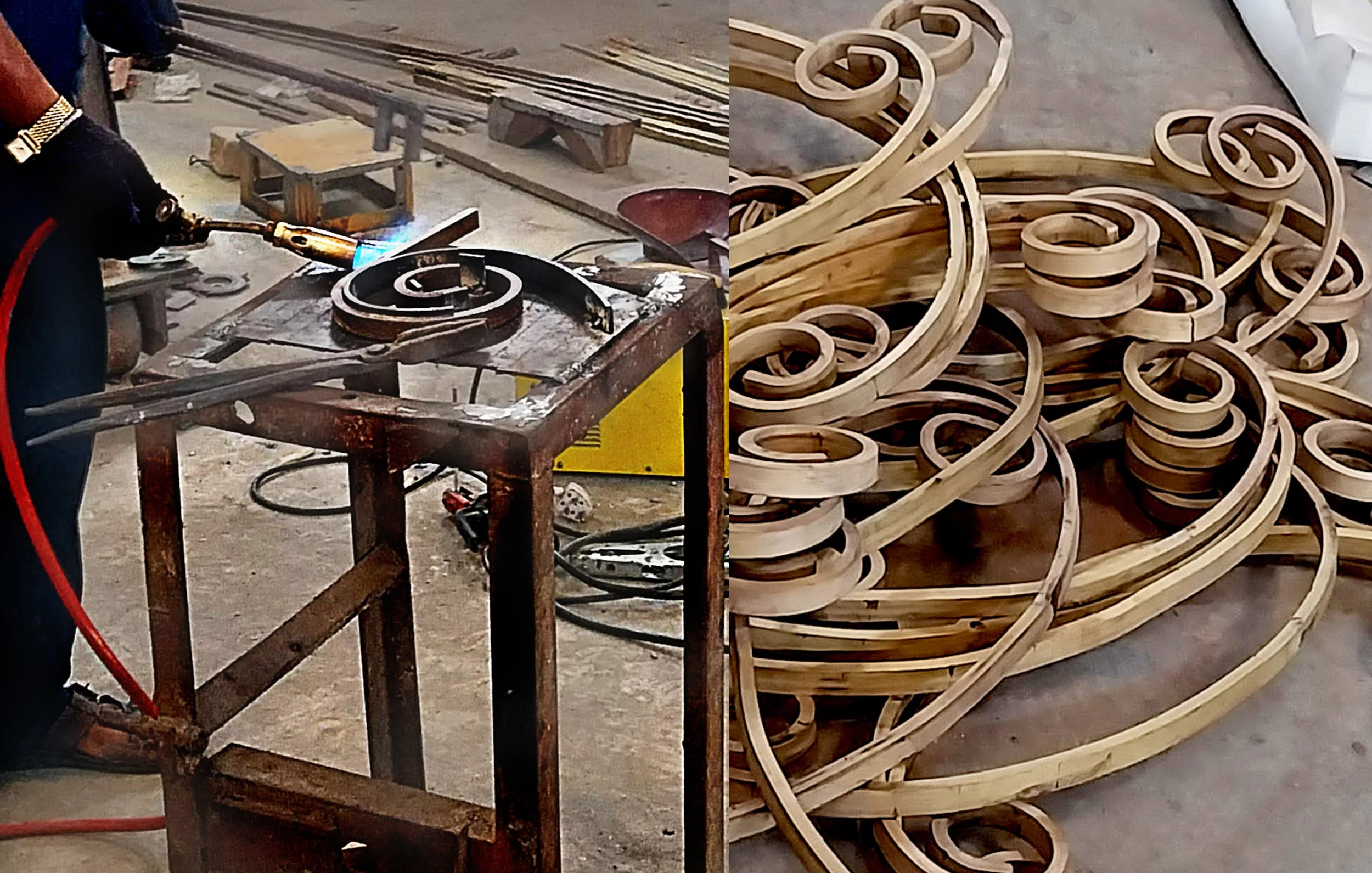
What Materials Let Us Do.
What Materials Let Us Do.
Something I've been thinking about lately:
The way we work a material seems to be closely tied to what the material is capable of doing.
Take metal. We have casting, forging, machining, sheet forming, fabrication. They are all ways of making things from metal, but each one takes advantage of a different behaviour of the material.
Then I started thinking about wood.
Carpentry, timber framing, boatbuilding, carving, turning. Again, completely different traditions have developed around the same material. A boatbuilder and a carpenter are both working with wood, but they are looking at it very differently.
The same thing happens with stone.
And that made me wonder: is this true of almost every material?
Maybe a lot of what we call craft is simply the accumulated knowledge of figuring out what a material will let you do with it.
We don't just choose a material and then make something from it. The properties of the material push us towards certain ways of making. Over time, those ways become techniques, trades and traditions.
Then 3D printing comes along and does something rather strange.
Instead of starting with the form the material naturally comes in—a block, a sheet, a bar, a plank—we ask whether we can make the material behave differently for a while.
Can it flow? Can we deposit it? Can it hold its shape? Can one layer bond to the next?
If it can, we can potentially build the object rather than carve it, forge it, bend it or assemble it.
And that means the same basic idea can be applied to very different materials.
I'm not sure where this leads yet.
But it does make me look at materials differently: not just as things we make with, but as things that already have a set of possibilities built into them.
Different Materials, Different Ways of Making
Something I've been thinking about lately:
The way we work a material seems to be closely tied to what the material is capable of doing.
Take metal. We have casting, forging, machining, sheet forming, fabrication. They are all ways of making things from metal, but each one takes advantage of a different behaviour of the material.
Then I started thinking about wood.
Carpentry, timber framing, boatbuilding, carving, turning. Again, completely different traditions have developed around the same material. A boatbuilder and a carpenter are both working with wood, but they are looking at it very differently.
The same thing happens with stone.
And that made me wonder: is this true of almost every material?
Maybe a lot of what we call craft is simply the accumulated knowledge of figuring out what a material will let you do with it.
We don't just choose a material and then make something from it. The properties of the material push us towards certain ways of making. Over time, those ways become techniques, trades and traditions.
Then 3D printing comes along and does something rather strange.
Instead of starting with the form the material naturally comes in—a block, a sheet, a bar, a plank—we ask whether we can make the material behave differently for a while.
Can it flow? Can we deposit it? Can it hold its shape? Can one layer bond to the next?
If it can, we can potentially build the object rather than carve it, forge it, bend it, or assemble it.
And that means the same basic idea can be applied to very different materials.
I'm not sure where this leads yet.
But it does make me look at materials differently: not just as things we make with, but as things that already have a set of possibilities built into them.